
To choose a mutual fund for SIP, match your goal’s time horizon to a SEBI category, check cost, consistency and risk, then start small and stay invested.
7 Actionable Steps to Choose Mutual Funds for SIP
If you’re choosing mutual funds for SIP, define your goal and time horizon, pick the matching SEBI category, shortlist funds on cost, consistency and risk, check portfolio overlap, and start a monthly SIP you can sustain. Review yearly, not daily.
- Write down the goal and the year.“₹20 lakh down payment in 7 years” is a goal. “Make money” is not.
- Map the horizon to a category. Use the table in the next section.
- Check your risk capacity. Read the scheme’s riskometer (Low to Very High) and ask whether you can stay invested through a 25% to 30% fall in an equity fund.
- Compare funds only within the same SEBI category. A flexi cap fund should be compared with other flexi cap funds.
- Screen on four filters: expense ratio, 5 to 10 year rolling returns against the category benchmark, fund manager tenure and fund size.
- Pick the plan type. A direct plan has a lower expense ratio than a regular plan because it carries no distributor commission.
- Start the SIP, then add a step-up. A step-up SIP raises your instalment by a fixed percentage each year, in line with your salary.
Key Takeaways:
- Goal first, fund second. Time horizon decides the category: under 3 years means debt or liquid, 3 to 5 years means hybrid, 7+ years means equity.
- SEBI sorts schemes into 5 groups and 36 categories(circular dated 6 October 2017). Compare funds only within the same category.
- Cost compounds. On a ₹10,000 monthly SIP over 25 years, a 1% higher expense ratio can cost roughly ₹26 lakh (worked example below).
- 3 to 5 funds are enough. More funds usually means overlapping holdings, not more diversification.
- The “80% rule” is a SEBI allocation rule, not a return promise (explained below).
- Review once a year, and shift to safer funds 2 to 3 years before the goal date.
How to Choose a Mutual Fund for SIP Based on Your Investment Goal?
Choose by the goal’s deadline. Retirement 15+ years away suits equity funds. A home purchase in 5 to 7 years suits hybrid or conservative equity mixes. Short-term savings under 3 years suit liquid or ultra-short debt funds. The shorter the deadline, the lower the equity share.
| Goal | Typical horizon | Suitable SEBI category (illustrative) | Risk level | Why |
| Retirement | 15 to 30 years | Flexi cap, index fund (Nifty 50 or Nifty Next 50), large and mid cap | High to Very High | Long horizon absorbs volatility |
| Buying a home | 5 to 7 years | Hybrid fund (aggressive or balanced advantage), large cap | Moderately High to High | Growth needed, but the deadline is fixed |
| Child’s education | 10 to 15 years | Flexi cap plus a debt fund as the date nears | High, reducing over time | Two-stage plan |
| Short-term savings | Under 1 to 3 years | Liquid fund, ultra-short duration, money market | Low to Low-Moderate | Capital stability matters more |
Categories are illustrative, not recommendations. Fund choice depends on your full financial situation.
Example 1: Retirement goal (age 35, retire at 60)
Horizon is 25 years, so equity is the core. A ₹10,000 monthly SIP at an assumed 12% annual return grows to about ₹1.88 crore on a ₹30 lakh investment. This is an illustration, not a forecast. A mix of a flexi cap fund and a Nifty 50 index fund keeps cost and complexity low.
Example 2: Buying a home (down payment of ₹20 lakh in 7 years)
At an assumed 10% return, you need a SIP of about ₹16,500 a month. Because the deadline is fixed, a pure equity fund is risky. A hybrid fund is more suitable. Move the money to a debt or liquid fund in the final 12 to 24 months.
Example 3: Short-term savings (₹50,000 in 12 months)
Divide ₹50,000 by 12 months, which is about ₹4,200 a month. At this horizon, equity SIPs are inappropriate because a market fall can erase gains before you need the money. A liquid fund or ultra-short duration fund fits better.
Read Also:
- Mutual Fund Investment Plans for Beginners in India
- 5 SIP Mistakes We Frequently See During Portfolio Reviews
- Best One Time Investment Plan – Complete Guide
- 20 Money Investment Ideas: Smart Ways to Grow Your Wealth
Which Mutual Fund Category is Right if my Time Horizon is in Years?
Match the number of years to the category: below 1 year, choose liquid funds; 1 to 3 years, choose short-duration debt; 3 to 5 years, choose hybrid; 5 to 7 years, choose large cap or aggressive hybrid; and 7+ years, choose flexi cap, mid cap or index funds.
| Your time horizon | Equity share to consider | Category to explore |
| Under 1 year | 0% | Liquid, overnight, money market |
| 1 to 3 years | 0% to 20% | Ultra-short, short duration, conservative hybrid |
| 3 to 5 years | 20% to 50% | Balanced advantage, equity savings, hybrid |
| 5 to 7 years | 50% to 70% | Large cap, aggressive hybrid |
| 7 to 10 years | 70% to 90% | Flexi cap, large and mid cap, index |
| 10+ years | 80% to 100% | Flexi cap, mid cap, small cap (small share), index |
These bands are common planning guidelines, not SEBI rules. Adjust them to your own risk tolerance.
Which Mutual Fund Scheme is Best for SIP?
No single scheme is best for every SIP investor. The best scheme is the one that matches your horizon, risk comfort and budget, belongs to a category with consistent rolling returns, and has a reasonable expense ratio. Compare funds only within the same SEBI category.
| Option | Best for | Cost | Risk | Watch out for |
| Index fund | Beginners, low-cost core | Lowest | Matches the market | Falls with the market |
| Flexi cap fund | 7+ year goals | Medium | High | Manager-dependent |
| Large cap fund | 5 to 7 year goals | Medium | Moderately High to High | May lag in a mid-cap rally |
| Hybrid fund | 3 to 5 year goals | Medium | Moderate | Tax depends on equity share |
| ELSS | Tax saving under the old regime (Section 80C) | Medium | High | 3-year lock-in |
| Liquid fund | Parking money for under 1 year | Lowest | Low | Returns are modest |
Which Mutual Fund is Best for a Beginner to Start SIP?
For beginners, a Nifty 50 index fund or a flexi cap fund is a common starting point, because both are diversified and easy to track. Start with one equity fund, add a second only when your monthly SIP exceeds ₹10,000, and keep a liquid fund for emergencies.
Mutual fund SIP options suitable for beginners:
- Index fund: low cost, no manager risk, tracks Nifty 50 or Sensex.
- Flexi cap fund: the manager can move across large, mid and small caps.
- Balanced advantage or aggressive hybrid fund: smoother ride if equity swings worry you.
- ELSS: only if you are in the old tax regime and need Section 80C.
Complete KYC once, and you can invest in any SEBI-registered scheme.
What is the 80% rule for mutual funds?
The “80% rule” usually refers to SEBI’s minimum allocation norms. A large cap fund must invest at least 80% of its assets in large cap stocks, and an ELSS must invest at least 80% in equity. It is a rule about what the fund must hold, not a promise about returns.
SEBI’s categorisation sets different minimums:
- Large cap: at least 80% in large cap stocks (top 100 by market capitalisation).
- Mid cap and small cap: at least 65% in the respective segment.
- Flexi cap: at least 65% in equity, with no cap restriction.
- ELSS: at least 80% in equity under the Equity Linked Savings Scheme rules.
Some investors also use “80:20” to mean 80% equity and 20% debt. That is a personal asset allocation choice, not a regulation.
How to Choose Mutual Funds for the Long Term?
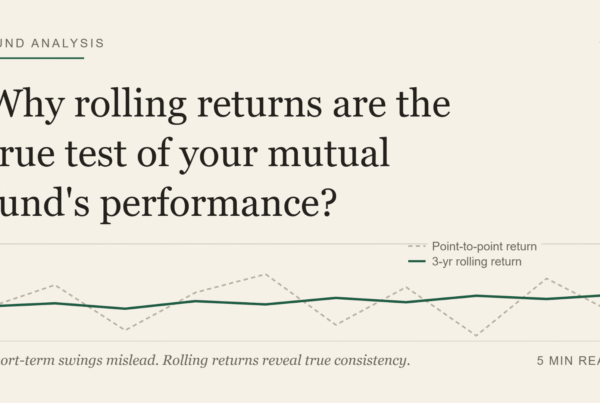
For long term goals of 7+ years, choose diversified equity funds in categories such as flexi cap or index, prefer low expense ratios, check 5- to 10-year rolling returns instead of point-to-point returns, and keep SIPs running through market falls.
Check here the long term checklist:
- Consistency over peak returns: a fund that is in the top half every year beats one that topped once.
- Expense ratio: under SEBI Regulation 52 of the Mutual Fund Regulations 1996, equity funds have a TER ceiling that tapers with fund size. SEBI has been reviewing the framework, so confirm the current limit.
- Fund house process: a stable team and a clear investment style.
- Automate a step-up SIP of 5% to 10% a year.
- Tax awareness (as of FY 2026-27, confirm with the latest notification): equity fund gains held over 12 months are taxed at 5% above ₹1.25 lakh a year, and short term gains at 20%. Debt funds purchased after 1 April 2023 are taxed at your income tax slab rate.
Inside Queries that Most Industry Leaders Don’t Talk About
These are three queries that investors pay attention to find the right answer before investing.
1: How many SIPs is too many? Check portfolio overlap
Running five SIPs does not mean five different portfolios. Two flexi cap funds can hold many of the same top 10 stocks. As a rule of thumb, if two equity funds share more than 60% to 70% of holdings, you are paying two expense ratios for one portfolio. Use the portfolio overlap tool on your platform or the fund factsheets before adding a new SIP.
A simple structure for a 30+ salaried investor:
- 1 index fund or large cap fund (core)
- 1 flexi cap fund (growth)
- 1 hybrid or debt fund (stability)
2: When should I stop or shift my SIP? Use a glide path
A SIP is not meant to run at full equity until the last day. For a goal date, reduce equity gradually over the final 2 to 3 years. For a home purchase in 2033, begin moving to hybrid and debt funds from 2030. You can also use an SWP (Systematic Withdrawal Plan) from a debt or hybrid fund to draw income after the goal date.
3: What does 1% extra cost really do? Regular vs. direct math
Assume ₹10,000 a month for 25 years and a 12% gross return, with the monthly rate approximated as the annual rate divided by 12:
| Plan | Expense ratio (assumed) | Net return | Approx. corpus |
| Direct plan | 0.8% | 11.2% | ₹1.63 crore |
| Regular plan | 1.8% | 10.2% | ₹1.37 crore |
The gap is roughly ₹26 lakh, an illustration and not a forecast. A regular plan can still make sense if you use a registered distributor who gives useful advice, handles paperwork and keeps you disciplined. Pay for advice only if you use it.
Common mistakes when choosing mutual funds for SIP
- Picking funds by last year’s top returns.
- Stopping the SIP during a market fall (the units you buy then are cheaper).
- Using equity funds for goals under 3 years.
- Holding too many overlapping funds.
- Ignoring expense ratio and plan type.
- Never reviewing, or reviewing every week.

How can Wealth Redefine Help You Choose mutual funds for SIP?
Wealth Redefine Financial Services LLP is an AMFI-registered Mutual Fund Distributor (ARN: 167127) and a BSE Star MF partner. We help investors map goals to categories, check portfolio overlap, set up step-up SIPs and review portfolios yearly. Ask for a goal-based SIP plan that follows your horizon and risk comfort.
Expert insight (add before publishing): [Quote from Soumya Sarkar, Founder, Wealth Redefine, with credentials and ARN reference]
Sources and third-party validation
- SEBI: Circular on Categorization and Rationalization of Mutual Fund Schemes (6 October 2017); Mutual Fund Regulations, 1996.
- AMFI (Association of Mutual Funds in India): SIP data, investor education and ARN verification.
- Income Tax Department: capital gains rules for equity and debt funds.
- Verify any distributor’s ARN on the AMFI website.
Frequently Asked Questions
Can I choose mutual funds for SIP without knowing my exact goal amount?
Yes. Start with a monthly amount you can sustain for at least 5 years, ideally 10 to 15% of take-home pay. Pick an index or flexi cap fund, then refine the target as your income grows by raising the SIP through a step-up.
How many mutual funds are enough for a SIP portfolio?
Three to five funds are enough for most investors. Beyond that, holdings overlap and returns converge toward the market while costs and tracking effort rise. One core fund, one growth fund and one stability fund is a workable structure.
Is a 5 year SIP good enough in equity mutual funds?
Five years is the minimum most planners suggest for equity, but results can still be negative if you exit in a falling market. For goals at 5 years, consider a hybrid fund and shift to safer funds in the final year.
What happens to my SIP if I switch jobs or miss an instalment?
Missing one instalment does not close the SIP in most cases. Funds typically stop the SIP after 3 consecutive failed debits. Keep the bank balance ready or reset the mandate, and the already invested units remain yours.
Should I choose a direct or regular plan for SIP if I am a beginner?
Direct plans cost less, but regular plans include distributor support. A beginner who will not research, rebalance or stay invested alone may gain more from guidance than the saved 0.5% to 1%. Choose based on how much help you need.
Do I pay tax on SIP every month or only on redemption?
Tax arises only on redemption, and each SIP instalment is treated as a separate purchase with its own holding period. As of FY 2026-27, equity fund gains are taxed at 12.5% above ₹1.25 lakh a year after 12 months. Confirm with the latest notification.
Is it safe to start a SIP when the market is at an all-time high?
A SIP spreads purchases across market highs and lows through rupee cost averaging, so timing matters less over 7+ years. It doesn’t protect against short-term losses, so match your equity allocation to your horizon.
Disclaimer: Mutual fund investments are subject to market risks. Read all scheme related documents carefully. Past performance is not indicative of future returns. Examples are illustrative and not investment advice.