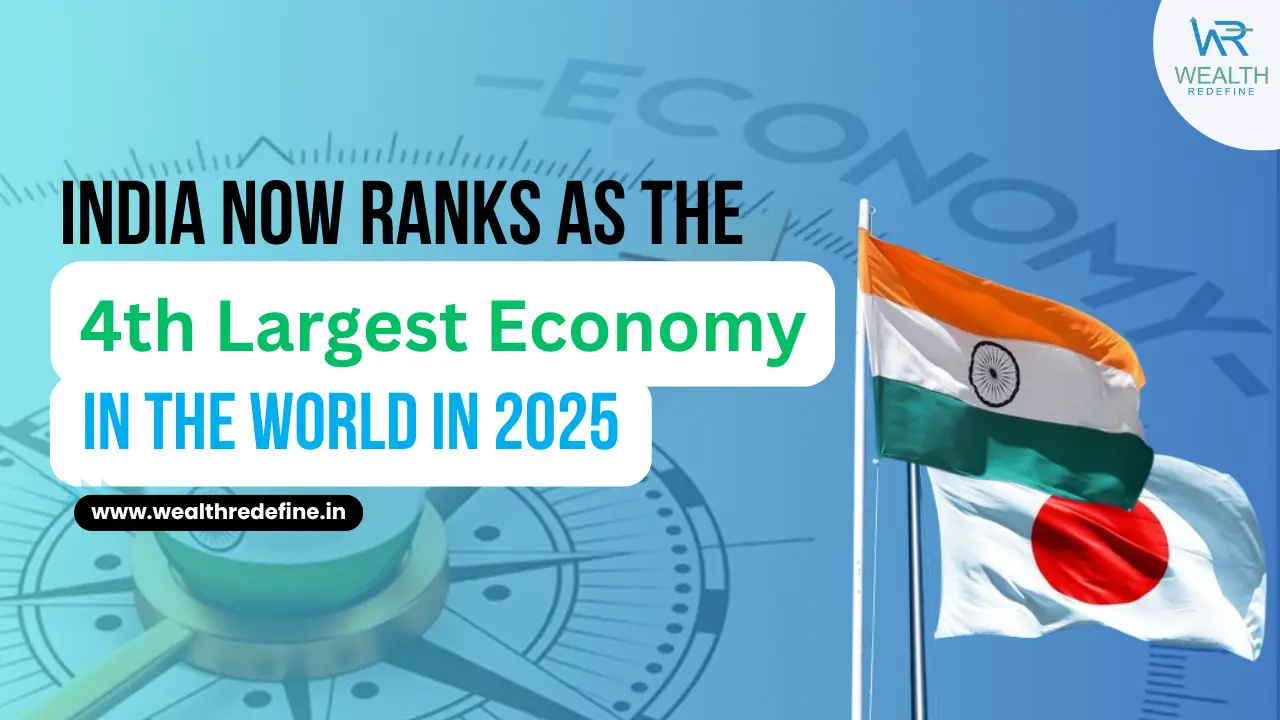
India has just made history—and every Indian has a reason to swell with pride. For the first time ever, we’ve overtaken Japan to become 4th largest economy in the world, confirms NITI Aayog CEO BVR Subrahmanyam. This isn’t just another statistic; it’s proof that India’s economic resurgence is real, and the world is taking notice.
What makes this achievement even sweeter is how far we’ve come. Just a few years ago, we were the fifth-largest economy. Today, with a roaring $4 trillion GDP, we’ve left Japan behind—thanks to bold reforms, digital revolution, and the relentless spirit of Indian businesses and workers. The IMF predicts our economy will hit $4.19 trillion by 2025, and experts say we’re on track to overtake Germany for the No. 3 spot within 3 years.
This is India’s moment. The question is no longer if we’ll rise, but how high we’ll go. Let’s explore what this milestone truly means—for our nation and for every Indian.
How did India overtake Japan to become the 4th largest economy? Key facts
India has now become the 4th largest economy in the world, moving ahead of Japan. Let’s understand how this happened in simple terms.
First, India is growing much faster than most countries. We are currently the fastest-growing major economy in the world. Experts say India will keep growing at over 6% for the next two years – no other big economy is growing this fast.
Second, Japan’s economy has been slowing down. Their growth is only 0.6%, which is very low. At the same time, problems like global trade wars are making it harder for Japan to grow faster.
Third, India has two big advantages:
- Our young population means more people working and spending
- Our digital growth and strong local businesses help the economy
Looking ahead, India’s GDP is expected to reach $5,584 billion by 2028. This means we could probably pass Germany to become the 3rd largest economy. Germany is struggling too – they expect almost no growth in 2025 and just 0.9% in 2026 because of trade problems.
In short, while other big economies are slowing down, India keeps moving forward. This is why we passed Japan, and why we might pass Germany as well. Now let’s dive into the details of the top 5 largest economies in the world.
The Top 5 Largest Economies in the World
Listed below are the top 5 largest economies in the world. Let’s take a closer look at them. Continue reading to understand their actual GDP, annual growth rate, and more.
1. The United States of America
The US remains the world’s largest economy with a massive $30.5 trillion GDP. That’s nearly one-fifth of the entire world’s economic output! What makes America’s economy so strong? It has everything – from tech giants like Apple and Google to powerful financial services and advanced manufacturing.
With each American contributing about $89,000 to the economy (GDP per capita), the country thrives on innovation and consumer spending. Though growing at 1.8% annually (slower than developing nations), its huge size and stable systems keep it at number one. The US has held this top position consistently since 1960, showing incredible economic staying power.
2. China
China is the world’s second-largest economy with a massive $19.23 trillion GDP. While that’s still smaller than America’s, China grows faster at 4% each year. Each Chinese citizen contributes about $13,690 to the economy (GDP per capita) – showing there’s still room to grow.
What makes China special is its transformation from a poor nation to an economic superpower since 1960. Known as the “world’s factory,” it leads in manufacturing and exports, while now developing strong domestic markets too. With 19% of global economic output, China continues closing the gap with the US through massive infrastructure projects and government-backed industries.
3. Germany
Germany holds third place with a $4.74 trillion economy – about one-fourth the size of China’s. Though its growth has stalled at 0% recently, each German contributes an impressive $55,910 to the economy (GDP per capita), showing their high productivity.
What makes Germany special? It’s Europe’s industrial powerhouse, famous for:
• World-class cars (BMW, Mercedes)
• Precision engineering
• Leading chemicals and medicines
The country thrives on exports, skilled workers, and constant innovation. While facing challenges from global trade issues, Germany still accounts for 3% of world’s economic output, remarkable for a country with just 83 million people.
4. India
Our incredible India has surged to become the 4th largest economy in the world with a $4.19 trillion GDP – a milestone that fills every Indian’s heart with pride! While our GDP per capita ($2,880) shows we’re still developing, what’s truly exciting is our blazing 6.2% growth rate – the fastest among major economies.
The world is noticing India’s rise:
• Our tech talent is powering global innovation
• Farm reforms are boosting rural incomes
• Manufacturing is gaining global recognition
• Young workforce is driving consumption
With 8.23% of global GDP (PPP), we’re just getting started. The IMF and RBI predict 6.5-6.6% growth ahead, fueled by our digital revolution, infrastructure boom, and rising middle class.
5. Japan
Japan now stands as the world’s 5th largest economy with a $4.19 trillion GDP, exactly matching India’s size but with a very different story. Each Japanese contributes $33,960 to the economy (GDP per capita), showing their advanced development, though growth has slowed to just 0.6%.
Japan’s economic strength lies in its legendary:
• Automotive giants (Toyota, Honda)
• Cutting-edge electronics (Sony, Panasonic)
• Precision machinery
• World-class financial services
Known for unmatched quality and work ethic, Japan remains a manufacturing and technology leader. However, with just 3.38% of global GDP (PPP) and slowing growth, the country faces challenges from an aging population and global competition, even as it continues producing some of the world’s most innovative products.
What’s Next for India? Future Outlook (2047)
India has come a long way – from being called a weak economy to becoming the 4th largest economy in the world. But this is just the start. By 2047, our 100th year of independence, we want to become a rich, developed country where every Indian earns at least $14,000 yearly.
To reach this big goal, the government has a clear plan focusing on:
- Making our economy stronger and bigger
- Giving people better skills and opportunities
- Creating jobs while protecting our environment
- Becoming leaders in technology
- Building strong ties with other countries
- Improving laws and systems
The good news? We’re already on track. With our young workforce and fast-growing businesses, India could become a $30 trillion economy by 2047. That means better lives for all of us – more jobs, better education, and modern facilities everywhere.
The future looks bright. Together, we can make India a country we’re all proud of!
Conclusion
India’s rise to the 4th largest economy in the world is a proud moment for all of us. More importantly, it brings exciting opportunities for Indian investors. With strong growth ahead, this is the perfect time to invest in our nation’s progress.
Mutual funds offer the safest and simplest way to benefit from India’s growth story. They let you invest in multiple sectors without risk. As our economy expands, your investments can grow too. Start small, stay consistent, and watch your money grow with India’s success!